THE SHORT VERSION
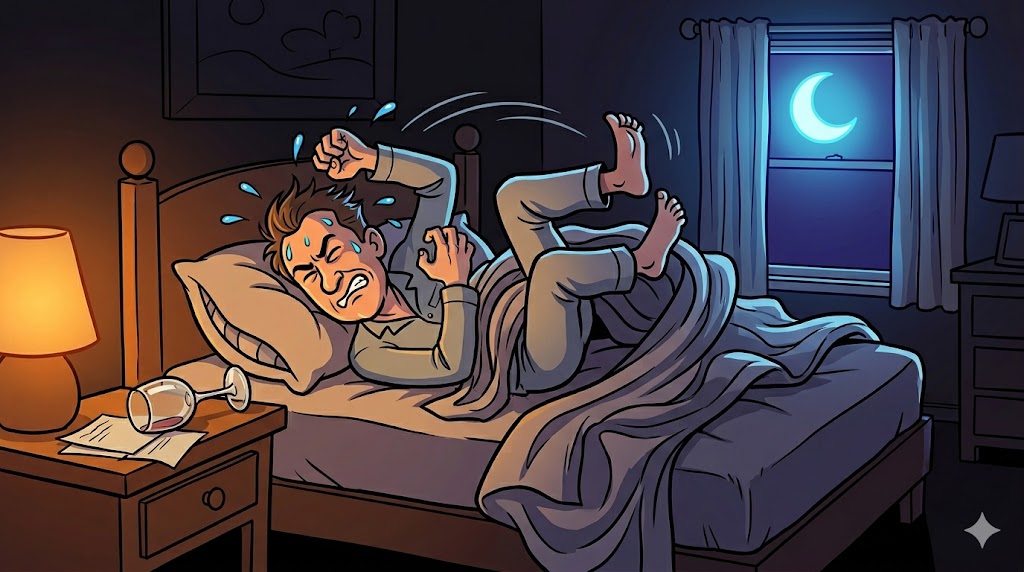
"Two drinks help me sleep" is a half-truth. Alcohol shortens sleep onset and can increase deep sleep in the first half of the night, but consistently delays REM onset and suppresses total REM percentage—even at low doses (≤0.50 g/kg, ~two standard drinks)
[2]. The second half of the night becomes fragmented, with REM reductions of −11.0 to −17.4 minutes and deep sleep declining after its early boost
[2]. Autonomic recovery (HRV) drops dose-dependently and can remain depressed into the following night
[4][6]. The question is not whether you fall asleep faster. It is whether the architecture you are buying is the one you actually need.
The Data
The Ebrahim baseline pattern. Ebrahim et al. (2013) reviewed controlled sleep experiments in healthy volunteers and described a repeatable trade: alcohol shortens sleep onset latency, makes the first half of the night appear more consolidated, and then increases sleep disruption in the second half [1]. The most reliable architecture change is REM timing. Across doses, the onset of the first REM period is delayed; at moderate and high doses, total-night REM percentage is decreased in the majority of studies reviewed. Slow-wave sleep (SWS; "deep sleep") tends to increase in the first half of the night, with total-night SWS increases more consistently seen at higher doses. Operator translation: alcohol swaps normal sequencing for a front-loaded night and a thinner REM budget.
Dose-response shows up first in REM. Gardiner et al. (2025) conducted a systematic review and meta-analysis (27 studies) and quantified a point that matters for "two drinks" drinkers: REM disruption shows up at what they classified as a low dose (≤0.50 g/kg, described as approximately two standard drinks) and worsens as dose rises [2]. Any "fall asleep faster" benefit was largely a high-dose phenomenon (shorter sleep onset latency and shorter latency to N3 were only observed at ≥0.85 g/kg, described as about five standard drinks). Deep sleep timing, however, is where the trap lives: across the full night, N3 duration was not significantly changed, but in the subset of studies that split the night, N3 increased in the first ~3 hours (reported ranges of +6.4 to +9.6 minutes) and then decreased in the second half (−5.2 to −6.4 minutes), alongside REM reductions in the second half (−11.0 to −17.4 minutes). In plain terms, alcohol can make deep sleep look "better" early while leaving later-night sleep worse.
Repeated nights look like a chronic pattern, not a one-off. McCullar et al. (2024) tested the scenario that matters in practice: alcohol before sleep across consecutive nights [3]. In a crossover design, 30 adults completed two three-night in-lab blocks with polysomnography each night: mixer-only versus mixer plus alcohol targeting a breath alcohol concentration of 0.08, ending one hour before lights out. Alcohol increased the rate of slow-wave sleep (SWS) accumulation and decreased the rate of REM accumulation at the start of each night. Over the full night, alcohol reduced total REM sleep but did not change total SWS. When sleep was examined in thirds (early/middle/late), SWS percentage was higher early but lower in the later portions of the night. Operator translation: the "two drinks nightly" pattern is not just "an alcohol night." It is a repeated re-writing of the night's stage distribution, with REM consistently losing.
The HRV hit is dose-dependent and can outlast the drinking window. Pietilä et al. (2018) used beat-to-beat recordings in 4,098 adults in everyday life and compared each person to his or her own nights without alcohol, focusing on the first three hours of sleep [4]. They grouped intake as low (≤0.25 g/kg), moderate (0.25–0.75 g/kg), and high (>0.75 g/kg), corresponding to average intakes of ~1.1, ~2.9, and ~7.0 drinks. Alcohol shifted autonomic balance dose-dependently: heart rate increased by +1.4 bpm, +4.0 bpm, and +8.7 bpm across low/moderate/high; RMSSD decreased by −2.0 ms, −5.7 ms, and −12.9 ms; and their HRV-derived "recovery percentage" dropped by −9.3, −24.0, and −39.2 percentage units. Grosicki et al. (2026) found the same directionality at population scale and also observed reduced next-day physical activity after drinking [5]. Brunner et al. (2024), at binge-level exposure with 48-hour ECG monitoring, illustrate the lag problem: parasympathetic HRV (RMSSD) was depressed during drinking and remained depressed through the recovery period, returning to normal circadian oscillation only during the subsequent night [6].
What This Means for Quality of Life
- Alcohol trades a cleaner start of the night for a messier finish. The common lived experience is early-morning wakefulness and lighter sleep in the hours when REM should be expanding
- Deep sleep minutes can look unchanged even when deep sleep becomes more front-loaded. That matters because the back half of the night is where many people decide whether they "slept fine" or "slept weird"
- HRV is often the more honest signal than sleep stage percentages on borderline nights. If nocturnal HRV is consistently lower on drinking nights, sleep is happening in a less parasympathetic state
- The cost is cumulative. Two drinks on a single night is noise. Two drinks on most nights is a structural change in weekly sleep architecture
- The cleanest comparison is within-person: alcohol nights versus non-alcohol nights, matched for bedtime and total time asleep. Group averages explain the mechanism; personal deltas show the price
The Longitudinal Question
Sleep architecture is not a goal to maximize one bar. It is an allocation curve across the night, repeated thousands of times across a decade. Alcohol turns that curve into a different shape: more slow-wave pressure early, less REM exposure overall, and more fragility in the second half when sleep is supposed to be lighter but not chaotic [1][2].
At Nexus Bio, we treat single-night sleep data the way a serious operator treats one day of market action: informative, not decisive. The problem with "moderate" drinking is that it often doesn't announce itself on a single chart. It shows up as a bias in the distribution. The useful move is to synthesize across time and tools: tag alcohol nights, compare them to non-alcohol nights, and look at both sleep stages and autonomic metrics (heart rate and HRV). Over months, that turns "I think alcohol doesn't matter for my sleep" from a belief into a measured delta.
The One Thing To Do This Week
Pull the last 90 days of sleep data from whatever wearable is already collecting it. Tag the nights that included two or more drinks. Then compare deep sleep and HRV on those nights and on the night after, not just the same night. The pattern is often subtle on any single date and obvious when stacked.
Nexus Bio is biological performance analytics for men who think in horizons, not quarters. Subscribe to the newsletter — one entry like this a week, delivered Tuesdays.