THE SHORT VERSION
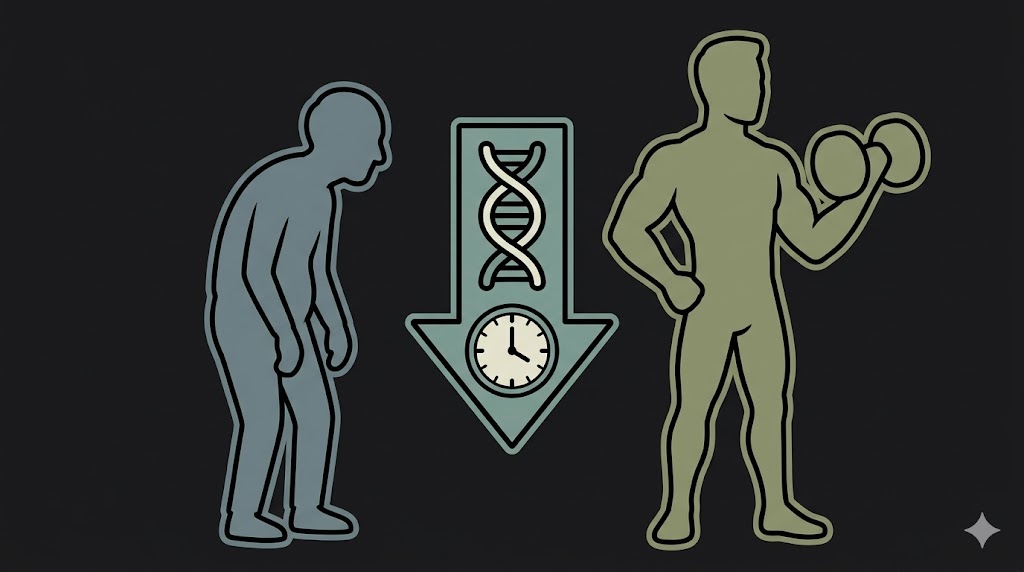
Muscle is not a cosmetic asset. It is the largest metabolic organ in the body, and men begin losing it at a rate of three to eight percent per decade starting at age thirty. That loss accelerates after forty. The decline does not present as a single diagnostic event. It registers as a quiet compounding of insulin resistance, reduced resting metabolic rate, accelerated bone density loss, and measurable shifts in cognitive resilience. Annual physicals rarely track lean mass, so the degradation passes unnoticed until functional capacity is already compromised. Resistance training is the only intervention demonstrated in the literature to reverse this trajectory, not merely slow it. The physiological return on two to three weekly sessions is disproportionate to the time invested. Most men assume cardiovascular fitness compensates for tissue loss. It does not. The question is whether the systems you depend on are being maintained, or simply managed until they fail.
The Data
The metabolic infrastructure thesis. Wolfe (2006) established skeletal muscle as the primary site of postprandial glucose disposal, accounting for approximately 80 percent of insulin-stimulated glucose uptake under normal physiological conditions [1]. Muscle mass is not inert tissue; it functions as a dynamic metabolic buffer that absorbs circulating glucose, clears inflammatory cytokines, and determines baseline resting energy expenditure. The operator translation is direct: lean mass dictates metabolic flexibility. As tissue declines, the body loses its primary sink for dietary carbohydrates, shifting the workload directly to the pancreas and accelerating insulin resistance independent of caloric intake.
The sarcopenia timeline. Rosenberg (1997) and subsequent longitudinal cohort analyses document a baseline loss of 3 to 8 percent of lean mass per decade after age 30, with the rate accelerating significantly after 40 and compounding further beyond 60 [2]. The degradation follows a predictable curve: type II fast-twitch fibers are preferentially lost, motor unit recruitment becomes less efficient, and resting catabolic signaling outpaces anabolic repair. The operator translation: aging is not a passive process of muscle loss. It is an active, unopposed shift toward tissue degradation. Without a mechanical counter-stimulus, the depreciation curve compounds exponentially.
The progressive overload requirement. Muscle adaptation requires a sustained increase in mechanical tension beyond established baselines. Performing identical repetitions with identical loads for months or years yields negligible physiological adaptation after the initial neural learning phase. The literature demonstrates that myofibrillar protein synthesis and satellite cell activation are directly proportional to the degree of progressive overload applied over time [3]. The operator translation: consistency without progression is maintenance, and maintenance is depreciation in biological terms. The stimulus must systematically exceed previous capacity to force structural adaptation. Most training failures occur here, not from lack of effort, but from lack of measured progression.
Cardiovascular training does not substitute for load. Sustained aerobic work (Zone 2) optimizes mitochondrial density, capillary network expansion, and cardiac stroke volume, as detailed in prior library entries. However, aerobic conditioning generates minimal mechanical strain and does not significantly stimulate type II fiber recruitment or myofibrillar hypertrophy. The two modalities operate on separate physiological pathways. The operator translation: running or cycling preserves the cardiovascular delivery system, but it does not preserve the metabolic tissue that receives the fuel. Both are required. Neither substitutes for the other.
The endocrine, skeletal, and mortality correlation. Compound loading acutely elevates anabolic signaling pathways, though chronic baseline testosterone shifts are modest and heavily contextualized by body fat percentage and recovery architecture [4]. More consistently, axial mechanical strain directly upregulates osteoblast activity, reversing age-related bone mineral density loss in men through Wolff's Law adaptation [7]. Epidemiologically, lean mass correlates strongly with longevity. Leong et al. (2015) analyzed over 140,000 adults across 17 countries and found grip strength—a direct proxy for systemic lean mass and neuromuscular integrity—to be an independent predictor of all-cause mortality, outperforming traditional blood pressure and BMI metrics in hazard ratios [5].
What This Means for Quality of Life
- Lean mass functions as a metabolic buffer, absorbing glucose spikes and reducing the insulin demand placed on the pancreas over decades
- Bone mineral density responds directly to mechanical loading; without progressive axial strain, age-related osteopenia compounds regardless of calcium intake or aerobic conditioning
- The testosterone response to lifting is frequently overstated in commercial fitness media; acute hormonal spikes do not equate to permanent baseline shifts, though improved body composition and sleep architecture reliably restore endogenous production
- Cognitive resilience tracks with peripheral insulin sensitivity and cerebral blood flow; preserving muscle mass reduces systemic neuroinflammatory load across the lifespan
- The minimum effective dose for metabolic preservation is two sessions per week; frequency beyond four yields rapidly diminishing returns for men prioritizing systemic health over sport-specific adaptation
- Annual physicals optimize for disease detection, not tissue preservation; lean mass is a leading indicator that requires intentional tracking to prevent silent functional depreciation
The Longitudinal Question
A single DEXA scan or body composition reading establishes a coordinate, not a trajectory. Muscle mass follows a predictable depreciation curve that begins in the early thirties, and the rate of decline is directly proportional to the presence or absence of mechanical stimulus over time. Single-point measurement fails because it cannot distinguish between natural aging and accelerated atrophy, and because blood panels provide zero visibility into structural tissue allocation. At Nexus Bio, we treat lean mass preservation the way a serious operator treats infrastructure maintenance: the relevant metric is the slope of the curve, not the absolute value at a given checkpoint. Synthesizing training frequency, progressive load progression, and recovery metrics across years reveals whether current habits are preserving metabolic function or quietly financing systemic decline. The gap between chronological age and biological age is measured in retained tissue. External instrumentation closes the blind spot that standard clinical panels leave open.
The One Thing to Do This Week
If resistance training is not currently on the calendar, put one session on it. Forty-five minutes. Compound movements — squat pattern, hinge pattern, push, pull. The weight does not matter this week. What matters is that the stimulus exists. Most men over 35 will discover that the gap between where they are and where they were is larger than they assumed. That gap is data.
Nexus Bio is biological performance analytics for men who think in horizons, not quarters. Subscribe to the newsletter — one entry like this a week, delivered Tuesdays.